
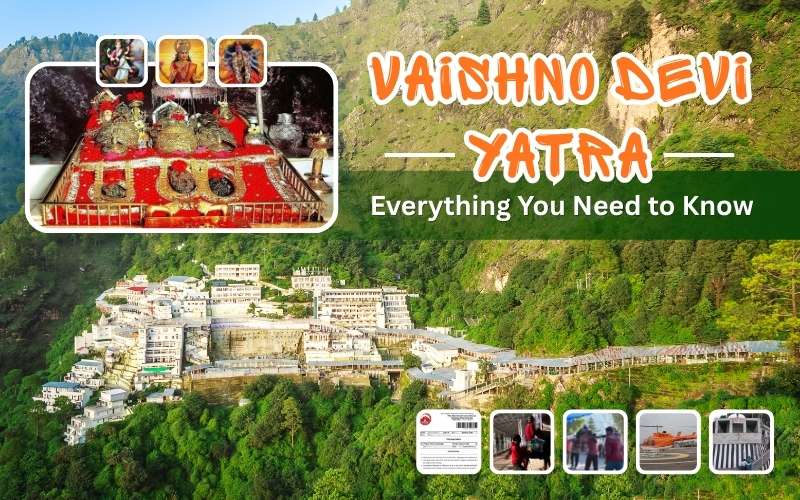
Vaishno Devi Yatra is one of the most revered pilgrimages of India. The Shri Mata Vaishno Devi Temple on Trikuta Hill in Jammu and Kashmir is one of the most revered Hindu shrines. The temple is dedicated to Mata Vaishno Devi, who is considered the manifestation of Goddess Durga. It is one of the 108 Shakti Peethas and receives more visitors than most other pilgrimage sites in India. The shrine draws over one crore visitors every year, with millions of devotees from around the world.
The temple is at an altitude of 5,200 feet and is reachable by a 13-kilometer trek from the base camp at Katra. The trail is well-maintained with gentle slopes and steps all the way. Refreshment centers and rest stops to recharge along the way. The shrine board’s facilities and beautiful scenery make the challenging trek more manageable. Most people do the trek in 5 to 6 hours, but it depends on your pace and stamina.
The journey is not as risky, but it helps to know a few important things before visiting Vaishno Devi. If you are planning a pilgrimage, this travel guide will assist you. It gives tips on how to get there, what to see, and how to make your trip memorable.
Vaishno Devi Temple is one of the most popular and sacred Hindu pilgrimages in India. The temple is perched at an altitude of 5,200 feet on the Trikuta Hill in Katra, Jammu, Kashmir, and can be reached by three modes of transportation: air, road, and rail.
By Air: The nearest airport to Katra is Jammu Airport, which is officially called Jammu Civil Enclave. You get regular flights from major cities like Delhi, Bengaluru, Chennai, Hyderabad, and Mumbai to reach Jammu. Katra is 50 km from Jammu. Taxis and cabs are easily available to reach Katra from Jammu Airport.
By Road: You get regular buses from North Indian cities to reach Katra. You can even book a personal cab or taxi to reach Katra.
By Railway: Over the years, Katra has established good connectivity with major cities with regular train services. The two nearest stations are Jammu Tawi and Shri Mata Vaishno Devi Katra Railway Station. If you are reaching Jammu Tawi, take a taxi or cab service to reach Katra, which is 50 km from the railway station.
The devotees are required to complete Vaishno Devi Yatra registration themselves before the commencement of the Vaishno Devi Yatra. Before starting the pilgrimage, they need to complete the registration and obtain the compulsory Yatra slip from a designated counter at Katra. This slip is valid for six hours from the time of issue, and pilgrims have to reach Ban Ganga within this time frame. It is checked at various points along the route.
In addition, pilgrims can complete the registration process and obtain the digital slip by going to the official website of the Shri Mata Vaishno Devi Shrine Board and selecting the appropriate option.
For online registration for the Vaishno Devi Yatra and to obtain the slip, please follow the steps below.
You can get the Yatra slip from the counters available at Katra if you have not registered online. However, this can mean long queues, especially in the peak season or during festivals. Advance registration online is always recommended.
Vaishno Devi Temple is visited by millions of devotees every year, particularly during the festival of Navratri. Most of the pilgrims prefer to climb the mountain to seek blessings from Mata. But there are some other ways also to reach Temple Bhawan. Let’s see the different options available for you to reach the Shri Mata Vaishno Devi Temple Bhawan and the Bhairav Nath Temple.
The most popular way to get to the temple is by trekking. But when you are planning your Vaishno Devi trip with family, you have to be well-planned to opt for the trekking option. The trek is over 13 km long, which can be strenuous for many, especially children and the elderly. Just above the Mata Vaishno Devi Temple is the Bhairav Nath Temple. The distance from Vaishno Devi Temple to Bhairav Nath Temple is just 1.5 km, but the steep climb makes the trek difficult. Vaishno Devi Mandir also provides cable cars, ponies, and palanquins to the Bhairav Nath Temple.
There are two ways to go to the main Bhawan from Ardhkuwari. Selecting the right one based on your fitness level and interest can make your overall experience better.
Both routes are well-maintained and safe. If this is your first visit, we recommend the old route, as it is more familiar and there are more facilities along the way.
The trek is 13 km and not everyone’s cup of tea. Trekking may be difficult for elderly people and children. So, you can go for ponies, porters, and palanquins while planning your Vaishno Devi trip with your family. Ponies carry adults. Porters carry luggage and babies/toddlers. Palanquins are available for elderly pilgrims. These services are under the control of the municipal committee. If you want to go trekking but need convenience for your children and parents, then this is the best option. The rates vary for each service. But one should always check the price before choosing any service.
Another way to reach Shri Mata Vaishno Devi Mandir is by helicopter ride. It’s convenient and time-saving, but also adds an element of fun and excitement to the overall experience.
Everyone, from children to the elderly, will enjoy the journey. You will get the ride from the Katra helipad, which is on the Udhampur road, just 2 km away from the bus stand. The helicopter ride is just 8 minutes from Katra to the Sanjichhat Helipad. It takes only 5-6 passengers at a time.
On arrival at Sanjichhat, trek to reach the Mata Vaishno Devi Temple. The main Bhawan is only a half-hour trek away. If you are not comfortable trekking, you can take ponies to reach the temple. Remember that if you want to use this service, you have to book the ride at least 2 months in advance.
These are the common routes to reach the main Bhawan of Shri Mata Vaishno Devi Temple. But the trek and Vaishno Mata Darshan are considered complete only when you visit the Bhairav Nath Temple at Vaishno Devi. You can either trek all the way from the Bhawan or get transport by pony, porter, or palanquin. Now, you also have the option of a ropeway for easy access to the temple.
The ropeway project from Katra to the Main Bhawan of Mata Vaishno Devi Temple is in process and will be completed soon. But the ropeway from the Vaishno Devi Temple to the Bhairav Nath Temple is fully functional. People of all ages can ride cable cars to get to the Bhairav Temple. Both temples are situated 1.5 km apart. You can reach Bhairav Temple from the Bhawan with a one-hour trek. But the steep climb is difficult for children and the elderly.
With cable cars, one can reach the temple in just 5 minutes. The cable car has a capacity of 45 passengers at a time, with a fare of Rs. 100 per person. Remember, the same ticket you get for Bhairav Nath Temple will be used for the return journey through the ropeway. So keep that ticket safe. Not only does this make the travel convenient, but the aerial view of the stunning valley makes the journey more exciting and adventurous for you.
The Vaishno Devi holy pilgrimage is the best vacation for families. Families embark on this spiritual journey to connect with the almighty Goddess Vaishno Devi and seek her blessings. Some opt for a helicopter ride to the Vaishno Devi Yatra. Some opt for trek. You can only reach the main temple and the Bhairav Nath Temple by helicopter ride. While trekking, you are bound to visit many shrines and temples to seek the Almighty’s blessings.
Bann Ganga, or Banganga, is a holy river and marks the beginning of the Vaishno Devi trek. People take a holy dip here before starting the trek. There are two big ghats where people take a holy dip. The name is derived from two words, ‘Ban’ meaning ‘arrow’ and ‘Ganga’ meaning the holy river of India. This river is connected to the history of Mata Vaishno Devi. It is said that Mata was going to her abode at Trikuta Hill, accompanied by a Langoor, or monkey, when he got thirsty. Then she shot an arrow into the land from whence water came. Since then, the river has been flowing.
Others refer to the place as Bal Ganga, which is associated with the story of Mata Vaishno Devi washing her hair in the river. Bal means hair; hence, this place is also known as Bal Ganga. By whatever name you call it, it is a place of worship for the Hindu devotees. You can stop here and rest. Visit the Bal Ganga Temple, which is regarded as the “Pratham Darshan,” the first darshan of the Vaishno Devi Yatra.
Charan Paduka is the next stop on your Vaishno Devi Trek. The temple is located at a distance of 1.5 km from Ban Ganga at an altitude of 3380 feet. Here, devotees can see the footprints of Mata Vaishno Devi, which were imprinted on a rock. After having the darshan of the holy feet of Mata, the pilgrims move ahead for the trek.
Adhkuwari is the midway point in the track to the Vaishno Devi Temple. This is one of the most important shrines to visit in the Vaishno Devi Yatra. This is not only a place to rest but also to visit the Adi Kuwari Temple. Adhkuwari cave is situated at an altitude of 4600 feet and is about 6-7 km away from Ban Ganga.
Ardh Kuwari is named after Adi Kuwari, or the eternal virgin. As per the Shri Mata Vaishno Devi story, Adhkuwari or Ardhkuwari is the place where Mata Vaishno, as a small girl, reached after making a stop at Ban Ganga and Charan Paduka.
As per belief, Vaishno Mata took shelter inside the cave and meditated for nine long months. The cave is womb-shaped. Mata Vaishno stayed in a cave like a mother’s womb for exactly nine months to observe spiritual discipline. The cave is called Garbh Joon, which means “a womb”.
There are two ways to reach the Bhawan from Adhkuwari. One is the old track passing through Sanjichhat, and the other is the new route passing through Himkoti. If you are tired of your trek, stopping at Himkoti would be the most rejuvenating experience. It’s a viewpoint of the new route, just 2.5 km from Ardhkuwari and nearly 4 km from the main temple.
Himkoti is not a religious place but a viewpoint. From here, you can see a mesmerizing view of the whole valley. People come here for the views and to relax. A sight that every tourist loved and kept forever. This is a perfect place to relax and enjoy the beautiful landscape. Take a break from your trek and visit Himkoti.
On crossing the famous shrines and temples in Vaishno Devi, you will finally reach the main Bhawan, where Shri Mata Vaishno Devi Cave is situated. The temple is approx. 6 kms away from Adhkuwari. Vaishno Devi Mata is known as the incarnation of Goddess Durga. The temple is a revered Hindu shrine and is one of the 108 Shakti Peethas.
Every visitor undertakes a pilgrimage to the temple. Devotees will not find statues, idols, or pictures of the goddess, but the three Pindis or rock forms of Maha Kali, Maha Laksmi, and Maha Saraswati. These Pindis represent Mata Vaishno Devi in three different forms.
The Pindis are naturally formed under a natural cave. Earlier, people used to crawl into the cave for Mata’s darshan, but it is now closed for safety purposes. The cave opens annually only in January and February when the rush is low. However, for easy access, a marble platform has been built.
The darshan at Vaishno Devi is different from most temple visits. The sanctum is a cave shrine, and for many people, that simplicity is what makes it so striking.
Queue management is structured. On busy days, waiting time can stretch from a couple of hours to significantly longer. On quieter weekdays, it moves faster.
What to carry inside: one piece of ID, a small water bottle, a light jacket (even in summer, especially for night arrivals), and minimal cash, along with UPI or a card that is accepted. Keep your hands free. A crossbody pouch is far better than overstuffed pockets when you’re navigating a cave queue.
Your trek to Vaishno Devi Mandir is incomplete without a visit to Bhairav Nath Temple, according to belief. The Bhirav Nath Temple is located within 1.5 km of the main Bhawan.
As per mythology, Mata Vaishno Devi cut Bhairavnath’s head with a sword when he was chasing her to marry her. His head landed up in the mountain far from where the Bhawan is now. A temple was built on the spot where Bhairav Nath was supposed to have died.
Your Vaishno Devi Yatra is not complete without visiting Bhairav Nath Mandir. So, visit Bhairav Nath Temple before you head back to Adhkuwari. Trekking to the temple is possible. But the steep climb may cause problems for many people. You get options like ponies, porters, and ropeways to reach Bhairav Nath Temple.
Most regular pilgrims will tell you yes. The temple sits higher than Bhawan, and yes, the climb feels steeper when your legs are already done. But the ropeway has changed things considerably. For families with elders, the ropeway makes this stop far more accessible.
Practical advice: if you’re genuinely exhausted, eat something, sit for a while, and then decide. Don’t push it if you’re dehydrated or dizzy. There’s no deadline.
Vaishno Devi is one of the top pilgrimage destinations in India, which remains crowded throughout the year. Every year, the place receives over one crore pilgrims. When planning the Vaishno Devi Tour, you can pick any time of the year based on your interests and schedule.
But the time to visit the Vaishno Devi Temple is between March and June. The temperature remains moderate during this time, with a maximum temperature of 31 degrees Celsius and a minimum temperature of 17 degrees Celsius.
Depending on the purpose of your visit and the itinerary of your Vaishno Devi tour package, the duration varies. However, the ideal duration for the trip is 2-3 days. Most people who are physically fit complete the trek in a day and return home.
People on a trip with their squad can visit and return within two days. However, if you are on a Vaishno trip with your family, including children and the elderly, you should consider adding an extra day, as the trip can be strenuous and exhausting.
Most pilgrims who visit Vaishno Devi are pleasantly surprised at the amount of food they get during the course of their journey, even on the trek. The base town, Katra, is peppered with cheap eats and cheerful little cafes where you can enjoy a decent breakfast before setting off, grab a wholesome lunch, or relax over dinner after a long day on your feet.
To top it all, the path leading to the Mata Vaishno Devi Temple is lined with eateries and small shops at regular intervals, so you don’t really have to worry about getting hungry mid-trek. The path is well-maintained, and the food choices along the way are truly varied, from quick bites and packaged snacks to freshly cooked meals. Some of the restaurants on the route are built high up, and the view of the valley is breathtaking; even a simple plate of dal and rice can seem like a memorable meal.
Perhaps the biggest surprise for pilgrims will be spotting big brands en route — McDonald’s at Ardhkuwari and Sagar Ratna at Bhawan — coexisting with traditional Bhojnalayas that serve simple, sattvic food in keeping with the spirit of the pilgrimage. These familiar options are especially reassuring for families traveling with young children or elderly members who would rather stick to what they know when it comes to food.
The Vaishno Devi Yatra is a strenuous journey. One should always be ready for the complexities one faces on the way to the temple and back. You don’t know what comes your way, making the journey challenging for everyone in the group.
Hence, it is crucial to plan your trip and be well-prepared. We hope our Vaishno Devi travel guide helps you plan your trip to Vaishno Devi—one of the top pilgrimage destinations in India. However, we suggest that, while undertaking the Vaishno Devi pilgrimage, you respect local customs, regulations, traditions, and spiritual sentiments.
The Vaishno Devi Yatra tour is a spiritual journey for devotees. By following the guidelines and travel tips we have shared above, you will have a transformative experience and a safe journey.