
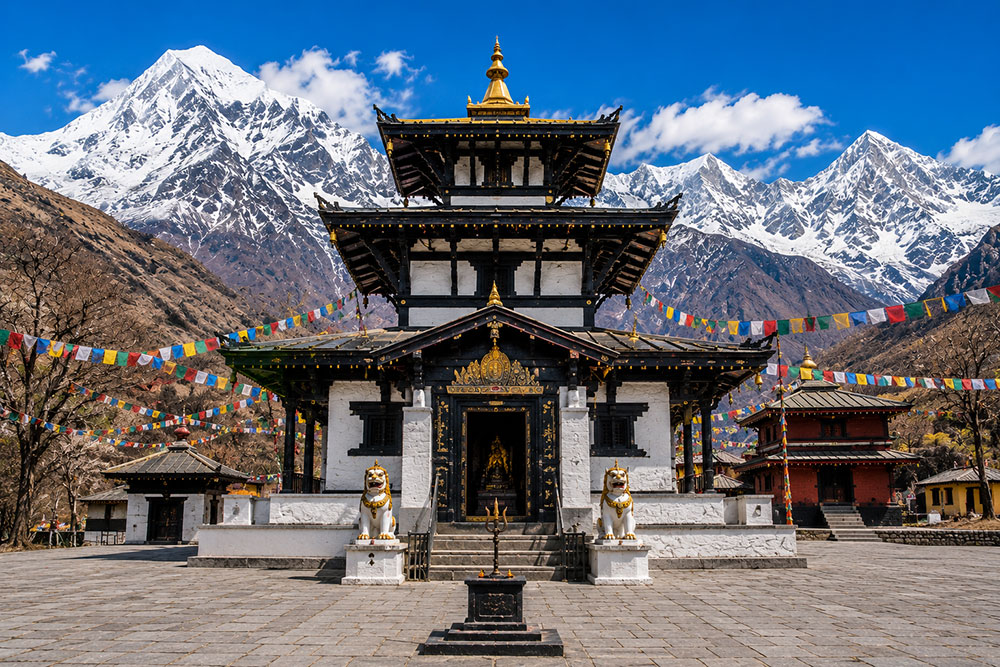
Situated at an altitude of 3,800 meters above sea level, Muktinath Temple is a famous pilgrimage site in Nepal’s Mustang district. The temple holds great significance among Hindu devotees, as it is dedicated to Lord Vishnu, one of the tri-devas. In fact, it is considered one of Hinduism’s eight sacred places and therefore holds a special place in the hearts of Hindu followers. In addition, it is also a revered pilgrimage site for Buddhists. As a result, the temple attracts thousands of Hindu devotees and Buddhists from all around the world every year to seek the blessings of their Lord and attain salvation.
According to Hindus, the shrine is called ‘Muktikshetra’, which means a place of salvation. On the other hand, Buddhists call this place ‘Chumig Gyatsa’, which means ‘a place of 108 waterspouts. The temple is dedicated to Lord Vishnu, who is worshipped by Hindus and Buddhists alike as the god of salvation. Therefore, the shrine is highly significant for both religions.
In Sanskrit, the word ‘Muktinath’ refers to the place of liberation. According to spiritual belief, if someone visits this temple and takes a dip in the holy waters that pour from 108 spouts, it will wash away all their sins, make them pious, and bring them closer to salvation.
The shrine complex consists of a Vishnu Temple and a Buddhist monastery. In the Vishnu Temple, there is a golden statue of Lord Vishnu, along with statues of many other Hindu deities, such as Goddess Lakshmi, Goddess Saraswati, Garuda, and Hanuman Ji. In the Buddhist monastery, there is a statue of Guru Rinpoche, the founder of Tibetan Buddhism.
The sacred Muktinath Temple is located in the Mustang District of Nepal. It also lies on the famous Annapurna Circuit Trekking Route. It is among the most sacred places for Hindu pilgrims and Buddhists. As a result, the shrine is crowded with thousands of pilgrims and tourists every year. Indian and Nepali tourists prefer to visit this temple during the Janai Purnima festival. The festival usually falls in August, and Hindu men visit this temple to change their sacred thread, which is commonly known as ‘Janai’.
The 108 water spouts are one of the key attractions of this mystical temple. These spouts are known as ‘Mukti Dhara,’ and thus, they are of great significance. These naturally formed stone water spouts (taps) are revered as sacred water sources. These water spouts are also depicted in some ancient Hindu scriptures. The icy cold water flowing from these magical spouts not only washes away sins but also purifies souls. With such spiritual significance, the spouts attract devotees from distant places to take a holy dip in them. This spiritual purification is believed to open the door to salvation.
With a nearby Buddhist monastery, Muktinath is among the few pilgrimage sites that reflect unity in diversity. As a famous Buddhist monastery dedicated to Guru Rinpoche, it offers a serene, meditative ambiance. The intricate Tibetan-style artwork and the monks’ learning and performance of daily rituals create a peaceful environment for delving deeper into the inner self and spiritual awakening.
When it comes to the Muktinath Temple architecture, its exquisite pagoda-style architecture and golden pinnacle are a real testament to Nepali craftsmanship. Adorned with fluttering prayer flags, the shrine creates an ambiance of complete devotion filled with melodic chants, prayers, and other spiritual sounds.
Adjacent to this sacred temple is the Jwala Mai Temple, known for its continuously lit flame. The natural flame emerging from the rock foundation is considered a divine manifestation and living proof of eternal energy and divine power. The magical flame leaves visitors spellbound, bringing them closer to the divine power.
Located at an elevation of 3,800 meters, the Muktinath Temple not only offers spiritual solace but also offers stunning views of the surrounding landscape. For ages, Muktinath has been an epitome of religious harmony, where both Hindus and Buddhists come to seek the blessings of Lord Vishnu and experience spiritual vibes spread across the Himalayan range.
Buddhists believe the place is sacred because Guru Rinpoche meditated here during his journey to Tibet. Therefore, the place holds great importance among Buddhist pilgrims, and many come to explore the spiritual sanctity of this ancient monastery. Nestled in the Himalayan Range, this pilgrimage site offers a variety of natural scenic attractions to explore.
Muktinath Temple symbolizes the rich cultural and spiritual heritage of Nepal. Being a significant spiritual site for Hindus and Buddhists, the place is well-crowded with thousands of devotees and tourists. Pilgrims and tourists visiting this site during festivals experience Nepal’s deep cultural heritage.
Apart from its spiritual significance, this site is blessed with many enchanting and thrilling natural sights, with a serene atmosphere. In a nutshell, the site is not limited to its spiritual significance; it also offers many surrounding natural wonders to explore.
During a visit to Muktinath Temple, visitors can enjoy a panoramic view of the surrounding Himalayan mountain ranges. Standing at around 8,167 meters, Dhaulagiri Mountain can be easily seen from the Muktinath Temple. Located west of Muktinath Temple, it is part of the Dhaulagiri Himalayan range.
Apart from that, a few other peaks, such as the Annapurna Range, the Nilgiri, and Tukuche Peak, offer breathtaking views to visitors. There are many other places and things to explore near this temple. Such natural wonders make Muktinath a popular tourist destination in Nepal.
If you are in search of a scenic trip from Muktinath Temple, do visit Marpha Village. Enriched with sprawling, lush apple orchards, it is known as the ‘Apple Capital’ of Nepal. Apart from apple orchards, you can explore cider and dried apple delicacies here. Munching fresh, hand-picked apples while roaming on the charming streets gives you a whole different experience. The district is rich in awe-inspiring natural beauty and deep-rooted cultural traditions, giving your pilgrimage tour a whole different experience.
If you are visiting this pilgrimage site during festive seasons, you can also explore Mustang’s cultural richness at its peak. It’s the Yartung Horse Festival, celebrated each year in or around August, which makes this area lively with traditional activities such as horse riding, archery, and folk songs and dances. The local Buddhists also celebrate a festival called the ‘Tiji Festival’. In this festival, the Tibetan Buddhists wear colorful masks, dance, and perform age-old rituals that symbolize the victory of good over evil. Witnessing these festivities helps you gain a deeper understanding into the local traditions and rituals.
When it comes to visiting the Muktinath Temple, the summer, spring, and autumn seasons are considered the most ideal times. Visiting this temple from March to May and from September to November offers ideal weather conditions to explore this hidden gem of nature. However, let’s understand the impact of different seasons on the weather in and around the Muktinath Temple area.
It is one of the most preferred seasons for tourists, making it a little crowded, as many local tourists visit this temple for various religious purposes, such as taking a holy bath at the 108 spouts of holy water. During this season, the climate is quite favorable for almost all modes of transportation. The sky remains clear, giving you crystal-clear views of the Himalayan ranges. Due to rising temperatures, you may miss out on the lush greenery and scenic sights. Much of the snow on the mountain peaks melts during this season.
Spring, we all know, is an enchanting season that unleashes nature’s creativity. It creates a delightful atmosphere around this pilgrimage site during this season, when a diverse range of plants and wildflowers adorn the landscape, and melting snow from the hill ranges feeds rivers and other water sources. The unique combination forms a mesmerizing, visually appealing scenic view worth capturing. The soothing and rejuvenating atmosphere allows you to rejuvenate your mind and deepen your spiritual experience.
The place welcomes spring after February, blessing the surrounding landscape with lush greenery and causing flowers and rhododendrons to bloom, spreading nature’s true fragrance.
As it is a busy season for working professionals, making it less crowded and therefore the most suitable time to explore this famous pilgrimage site and nature’s creativity by visiting many scenic natural attractions nearby or around this temple in Nepal. Moreover, the trekking trails are also less crowded, allowing you to enjoy a more peaceful and leisurely experience.
The autumn season also offers favorable atmospheric conditions to explore this pilgrimage and natural site. Apart from ideal weather conditions, many major Hindu festivals (like Dashain, Tihar, etc.) fall under this season, making it more significant from a pilgrimage tour perspective. So, visiting this destination in autumn lets you witness local traditions and rituals, as well as how the festivals are celebrated here. Visiting the Muktinath temple in autumn allows you to delve deeper into its cultural richness as part of the same tour package.
If you are planning to visit this pilgrimage spot during winter, it offers a whole different, more scenic and tranquil experience, best suited for those who seek solitude. The snow-capped peaks of the Dhaulagiri and Annapurna ranges behind the temple offer a captivating scenic view. However, you may encounter snowfall, which can cause travel delays and affect your overall tour. Stay prepared for this weather by taking precautionary measures. Don’t forget to pack warm clothes to make your tour more comfortable.
If you are considering it as a monsoon (June to August) pilgrimage destination, this pilgrimage tour may offer glimpses of nature’s real beauty at its vibrant best, while also posing some challenges and risks. During the season, heavy rainfall makes this place more prone to landslides, affecting transportation and accessibility. Before starting your monsoon pilgrimage tour to Muktinath, check the weather forecast, road conditions, and other transport options, as well as other factors that could turn your tour into a horrible experience rather than an enjoyable and alluring one.
Upon gaining insight into the impact of different seasons on the Muktinath pilgrimage tour, one can recognize that Spring and Autumn are the ideal seasons to visit this temple in Nepal and explore the adventurous side of the pilgrimage with Himalayan adventure while enjoying spiritual enlightenment.
With good connectivity, Muktinath Temple offers various options for pilgrims and tourists to reach it. The most convenient way is to take a direct flight from New Delhi to Kathmandu, a journey of only 2.5 hours. Upon reaching Kathmandu, you can take a domestic flight from Kathmandu to Jomsom, the closest airport to the temple. The 25-minute flight to Jomsom will offer breathtaking views of the Himalayan mountains.
Pilgrims can also travel to Muktinath Temple via the Sunauli border crossing in Uttar Pradesh. From Sunauli, you can take a bus or taxi to Pokhara and continue your journey to Muktinath. Though the trek from Pokhara to Muktinath Temple usually takes around a week, visitors can enjoy the scenic beauty of the surrounding Annapurna region.
The short answer is no! Indian citizens don’t need a visa or a passport to visit Nepal. The reason is that Nepal shares an open border with India, so no passport or visa is required. All you need to present is your Aadhaar Card or PAN card, that too only if required.
During a visit to Muktinath Temple, tourists have various accommodation options to choose from. It ranges from basic lodges to luxurious hotels, so that you can choose your comfort level based on your budget. However, if you want to stay closer to the temple to make the most out of your temple visit, you can stay at any of the basic guesthouses and lodges present in the complex area. Such guesthouses offer clean rooms, shared bathrooms, and simple meals.
For more comfortable accommodations, you can go to the closest town, Jomsom, where resorts and hotels offer luxurious accommodations. The hotels are also equipped with modern amenities, including comfortable rooms with attached bathrooms, 24-hour electricity, Wi-Fi access, breakfast, and meals.
If you are planning to explore this sacred pilgrimage site in Nepal, it’s best to consult an experienced tour or travel agency. The reason is that such companies take care of your end-to-end pilgrimage tour requirements as per the tour package you have chosen. The tour package may also include accommodation; sometimes it may be excluded. So, it’s better to be sure about the package before opting for it. Choose the best Muktinath Temple tour package and explore this sacred pilgrimage to the fullest, hassle-free.
Muktinath Temple is a famous pilgrimage destination in Nepal. Due to an open border with India, it’s easily accessible from India as well. If you are seeking a pilgrimage destination offering an unforgettable once-in-a-lifetime experience, do visit the Muktinath Temple. Choose a tour and travel partner that offers a best-in-class Muktinath Temple package tailored to your requirements efficiently. Choose the best Muktinath Temple tour package and unleash your spiritual side.