
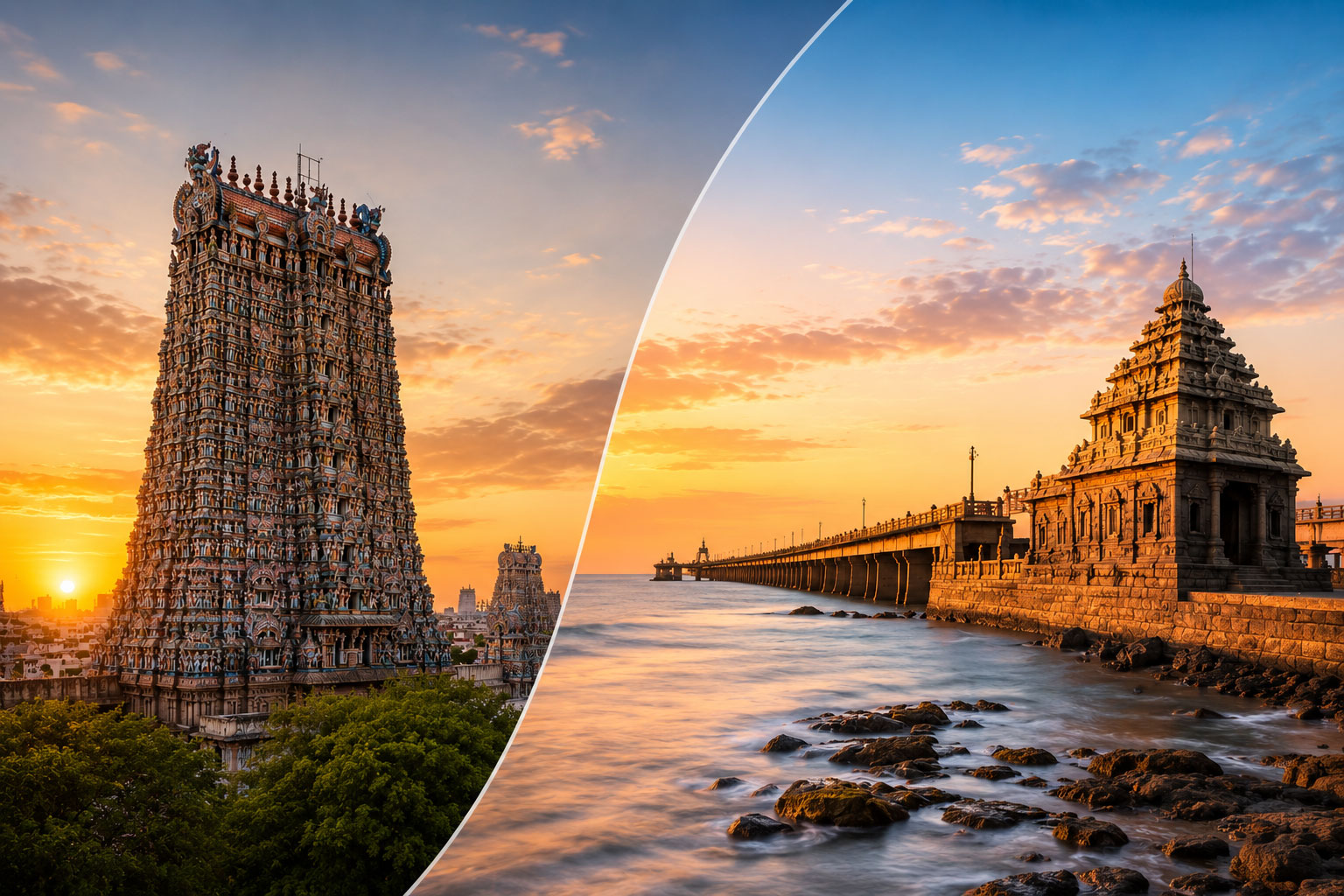
Madurai and Rameshwaram are two of the most revered pilgrimage destinations in South India. Whether you are a devoted pilgrim seeking divine blessings or a spiritual traveller drawn to ancient temples and sacred traditions, these two Tamil Nadu cities offer a deeply enriching experience. Rameshwaram is one of the four sacred Char Dham sites and is home to the Ramanathaswamy Jyotirlinga - one of the twelve holiest Shiva shrines in India. Madurai, on the other hand, is the cultural and spiritual heart of Tamil Nadu, anchored by the magnificent Meenakshi Amman Temple.
This guide covers everything you need to know before planning your Madurai and Rameshwaram pilgrimage - key temples, other attractions, local food, the best time to visit, and how to reach both cities.
Located on the banks of the Vaigai River in southern Tamil Nadu, Madurai is one of the oldest continuously inhabited cities in India and a cornerstone of Tamil culture and heritage. It is internationally recognised for the Meenakshi Amman Temple, an architectural marvel that encapsulates centuries of Tamil craftsmanship, devotion, and classical tradition. Madurai has earned several enduring titles 'Temple City of India' and 'Athens of the East' and it lives up to every one of them.
The city is a seamless blend of ancient tradition and modern life. Age-old rituals are observed daily alongside vibrant bazaars, classical festivals, and flourishing street food culture. For pilgrims, Madurai is far more than a stopover - it is a destination in its own right, where every lane carries a piece of Tamil Nadu's living heritage.
The Meenakshi Amman Temple is undoubtedly the soul of Madurai. Dedicated to Goddess Meenakshi (a form of Goddess Parvati) and her consort Lord Sundareswarar (Lord Shiva), this temple is among the largest and most visited temples in India. Its towering gopurams (gateway towers) adorned with thousands of intricately painted sculptures are visible from across the city and are a breathtaking sight at dawn and dusk.
Inside the temple complex, the 1,000-Pillared Hall is a landmark in itself, each pillar bearing unique carvings. The musical pillars in the hall produce distinct musical notes when tapped - a feat of ancient acoustical engineering. Other highlights include the golden lotus pond, the Nataraja idol depicted mid-dance with one leg raised, and the richly painted ceilings of the Kilikoondu Mandapam. The evening Alankara Darshan and the nightly procession of Lord Sundareswarar to Goddess Meenakshi's chamber are among the most spiritually moving rituals for devotees.
Built in 1636 AD by King Thirumalai Nayak, this grand palace stands as a testament to the Nayak dynasty's royal heritage. Located in the heart of Madurai, the palace showcases a rare and striking blend of Dravidian and Rajput architectural styles. Its towering domes, ornate stucco work, magnificent pillars, and intricately carved gateways make it one of the finest examples of 17th-century South Indian palace architecture. The complex houses a museum displaying artefacts from the Nayak period. An evening sound-and-light show (conducted in Tamil and English) brings the palace's history to life.
Located approximately 12 kilometres from Madurai, near the village of Keelakuyikudi, the Samanar Hills hold deep historical and religious significance. Rock inscriptions on the hillside depict Jain monks who are believed to have meditated in the natural caves here centuries ago. The Archaeological Survey of India has designated the site as a protected monument. Beyond their historical importance, the hills offer panoramic views of the surrounding landscape, making them a worthwhile visit for those with an interest in Jain heritage or early Tamil history.
The Vaigai River, which flows through Madurai, holds both cultural and religious importance for the city. The Vaigai Dam, located near Gudalur (approximately 55 kilometres from Madurai), is a scenic spot popular with visitors. Standing 106 feet in height and stretching 11,675 feet in length, the dam has a water storage capacity of 71 feet. The lush garden surrounding the dam is a pleasant spot to relax during a visit.
• Kodaikanal: a picturesque hill station, around 120 km from Madurai
• Theni: known for the Periyar River and scenic hill ranges
• Meghamalai: a quiet high-altitude retreat with tea and cardamom estates
• Dindigul: famous for its rock fort, biryani, and lock-making heritage
• Kanyakumari: the southernmost tip of India, where three seas meet
Madurai has a culinary identity as distinctive as its temples. Street food here is legendary, and the city's beverages are celebrated across Tamil Nadu. Do not leave Madurai without trying the following:
Jigarthanda: Madurai's most iconic drink, a chilled concoction of nannari syrup, condensed milk, badam pisin (almond gum soaked overnight), and ice cream. It is thick, sweet, and utterly refreshing.
Keerai Vada: A deep-fried, doughnut-shaped snack made from crushed urad dal, cumin, pepper, and murunga (drumstick) leaves. Typically served hot with tea at street stalls.
Madurai Idli: Softer and fluffier than the standard version, best enjoyed with coconut chutney and a fiery red chilli sauce that is unique to Madurai.
Paruthi Paal: A nourishing drink made from cottonseed extract blended with coconut milk, flavoured with cardamom and ginger, and sweetened with jaggery. Served chilled during summer, it is both filling and cooling.
Madurai can be visited year-round, but October to March is the most comfortable period due to cooler temperatures. Summers (April to June) can be hot and dry. The Meenakshi Thirukalyanam festival, celebrated in April-May, is one of the grandest temple festivals in Tamil Nadu and draws lakhs of devotees annually, plan early if you intend to attend.
Madurai is well connected by all three modes of transport:
By Air: Madurai Airport (IXM) has direct flights from major Indian cities including Chennai, Bengaluru, Mumbai, Delhi, and Hyderabad.
By Train: Madurai Junction is a major railway hub. Notable trains include the Madurai Express from Chennai and the Vaigai Express. Several trains also connect directly from Bengaluru, Coimbatore, and Mumbai.
By Road: Madurai is connected by National Highway 44 (Chennai–Kanyakumari corridor). State and private buses operate frequently from Chennai (approximately 9–10 hours), Coimbatore (4 hours), and Bengaluru (8–9 hours).
Madurai offers accommodation to suit all budgets. Luxury travellers can choose from properties like the Taj Gateway or Heritage Madurai near the temple area. Mid-range pilgrims are well served by hotels on Town Hall Road and West Masi Street, both close to the Meenakshi Temple. Budget lodges and dharamshalas are also available around the temple zone. Advance booking is recommended during festival seasons and long weekends.
Situated on Pamban Island off the southeastern coast of Tamil Nadu, Rameshwaram is one of the four sacred Char Dham pilgrimage sites in Hinduism, alongside Badrinath, Dwarka, and Puri. The town derives its immense spiritual significance from the Ramanathaswamy Temple, which enshrines one of the twelve Jyotirlingas, the most sacred manifestations of Lord Shiva.
According to Hindu scripture and the Ramayana, Lord Rama worshipped Lord Shiva here before constructing the Ram Setu (Adam's Bridge) across to Lanka to rescue Goddess Sita. This mythological connection makes Rameshwaram one of the most sacred pilgrimages for Hindu devotees, and millions visit each year to seek the blessings of Lord Shiva and complete their Char Dham yatra.
The Ramanathaswamy Temple is the spiritual epicentre of Rameshwaram and the primary reason most pilgrims make the journey here. It is one of the twelve Jyotirlinga temples in India and a mandatory stop on the Char Dham pilgrimage circuit. The temple is believed to have been established at the spot where Lord Rama installed the Shivalinga before beginning construction of the Ram Setu bridge to Lanka.
The temple's architecture is awe-inspiring - it features the longest temple corridor in India, stretching over 1,200 metres, lined with ornately carved pillars. The temple houses 22 sacred theerthams (holy water tanks), and bathing in all 22 is considered a deeply purifying ritual that devotees undertake before the main darshan. The 38-metre-tall Gopuram at the eastern entrance is one of the tallest in South India.
Pilgrims seeking relief from Kala Sarpa Dosha (a specific astrological affliction) also visit Rameshwaram for dedicated pujas conducted by temple priests. Darshan timings are structured; it is advisable to arrive early morning to avoid long queues and to complete the theertham ritual before the temple gets crowded.
Agni Theertham is the sacred sea beach adjacent to the Ramanathaswamy Temple. A dip in its waters is the first ritual that pilgrims are expected to perform upon arriving in Rameshwaram, before entering the temple for darshan. The waters here, where the Bay of Bengal meets the Indian Ocean, are believed to cleanse the sins of devotees. It is one of the most spiritually significant stops on any Rameshwaram pilgrimage.
Located about 20 kilometres from Rameshwaram, Dhanushkodi is a ghost town of extraordinary historical and spiritual significance. Once a thriving coastal settlement with a railway station, post office, and a sizeable population, Dhanushkodi was completely devastated by a massive cyclone in 1964. The government subsequently declared it uninhabitable, and it has remained a deserted ruin ever since.
Today, Dhanushkodi is visited both for its eerie, haunting beauty and for its religious significance, it is believed to mark the tip of the Ram Setu, the legendary bridge built by Lord Rama's vanara sena. The ruins of the old church, railway station, and houses rising from the sands make for an unforgettable sight. The point where the Bay of Bengal meets the Indian Ocean is also clearly visible here.
The Pamban Bridge is a landmark connecting mainland Tamil Nadu to Pamban Island (on which Rameshwaram stands). Opened in 1914, it was the first sea bridge in India and remained the longest sea bridge in the country for decades. The bridge stretches approximately 2.3 kilometres over the Palk Strait. Its famous Scherzer rolling lift span, which can be raised to allow ships to pass beneath, is a remarkable feat of early 20th-century engineering. Crossing the Pamban Bridge by train, especially at dawn or dusk is a memorable experience in itself.
The town of Rameshwaram is a living example of a traditional South Indian pilgrimage settlement. The streets near the temple are lined with vendors selling flowers, coconuts, vermillion, and puja materials. The town is notably clean and well-managed a rarity among large pilgrimage towns in India. Visitors can witness the unhurried rhythms of local life: fishermen returning with the morning catch, priests performing rituals at street-side shrines, and the bells of the temple echoing through the lanes.
• Dr. APJ Abdul Kalam Memorial: a tribute to India's Missile Man, who was born in Rameshwaram
• Villoondi Theertham: a freshwater spring on the seashore, believed to have been created by Lord Rama
• Gandhamadhana Parvatham: a hillock housing the imprint of Lord Rama's feet, offering a panoramic view of the island
• Panchmukhi Hanuman Temple: a temple dedicated to the five-faced form of Lord Hanuman
• Ariyaman Beach: one of the cleanest and most scenic beaches in Tamil Nadu, suitable for a leisurely visit
Rameshwaram's coastal location means its local cuisine is heavily influenced by the sea. Most restaurants here serve both vegetarian and non-vegetarian options. Some must-try dishes include:
Meen Kuzhambu: A traditional fish curry cooked in a tangy tamarind and tomato base, spiced with red chillies and aromatic South Indian spices. A staple of Rameshwaram's coastal cuisine, it is best enjoyed with steamed rice.
Curd Rice: A simple, cooling dish of boiled rice mixed with yogurt and tempered with mustard seeds, green chillies, and curry leaves. An ideal option for pilgrims seeking a light and settling meal after a long day.
Filter Kaapi: The quintessential South Indian filter coffee: brewed from freshly ground coffee and chicory, blended with frothed, sweetened milk. It is poured repeatedly between a tumbler and dabarah to achieve the perfect froth and temperature.
Karupatti Paniyaram: Small, round, sweet dumplings made in a special paniyaram pan using rice batter and palm jaggery (karupatti). The palm jaggery gives the dish a distinctive earthy sweetness that is quite unlike regular sugar.
Puliyodarai: A traditional tamarind rice dish tempered with curry leaves, black gram, peanuts, and dried red chillies. Commonly offered as temple prasad in Rameshwaram, it is widely available at local eateries as well.
October to March is the ideal time to visit Rameshwaram. The weather during this period is mild and pleasant, making it comfortable to complete the outdoor rituals, including the theertham baths and the walk to Dhanushkodi. Summers (April to June) can be intensely hot and humid given the island's coastal location. Maha Shivaratri is the most significant festival at Ramanathaswamy Temple and draws enormous crowds book accommodation well in advance if you plan to attend.
By Air: The nearest airport is Madurai International Airport, approximately 180 kilometres from Rameshwaram. From Madurai, you can take a train, bus, or taxi to Rameshwaram (approximately 3.5-4 hours by road).
By Train: Rameshwaram has its own railway station (Rameswaram Railway Station) directly connected to several major cities. The Rameswaram Express from Chennai is a popular option. Trains cross the iconic Pamban Bridge, making the arrival by rail particularly scenic.
By Road: Regular Tamil Nadu State Transport Corporation (TNSTC) buses and private buses operate from Madurai, Chennai, Trichy, and other major Tamil Nadu cities. The drive from Madurai takes approximately 3.5 hours via NH87.
Rameshwaram has seen steady development in its hospitality sector to cater to the large influx of pilgrims year-round. Options range from budget lodges and dharamshalas (pilgrim rest houses) close to the temple, to mid-range hotels offering comfortable rooms along the main streets. The Tamil Nadu Tourism Development Corporation (TTDC) also operates a hotel here. Accommodation fills quickly during Maha Shivaratri and other major Hindu festivals, so advance booking is strongly recommended.
A combined visit to Madurai and Rameshwaram is one of the most fulfilling pilgrimage journeys you can undertake in South India. Together, they offer a complete spiritual experience, the cultural and devotional richness of the Meenakshi Amman Temple in Madurai, and the profound Char Dham significance of the Ramanathaswamy Jyotirlinga in Rameshwaram. Most pilgrims cover both cities in 3 to 5 days, with Madurai serving as the natural gateway since it has the closest major airport.
Plan your itinerary keeping temple timings in mind, carry comfortable cotton clothing suited to the coastal and temple town climate, and if possible, engage a local guide at Ramanathaswamy Temple to help navigate the 22 theertham ritual. With the right preparation, your Madurai and Rameshwaram pilgrimage will be an experience you carry with you for a lifetime.